preparing for difficult conversations
Difficult conversations do not need to feel chaotic.
A practical framework to help you prepare, lead clearly, and walk in steady.
This short online course is for leaders, managers and professionals who care about their work and their people, but find themselves overthinking the hard conversations.
Start with the first lesson free and experience the preparation framework in action.

Try the First Lesson
Start with the first lesson and see how the preparation framework works in practice.
If it feels useful, you can unlock the full course and continue through the remaining steps.
START THE FIRST LESSONDifficult Conversations are not a confidence problem.
They are usually a preparation problem.
Most capable professionals do not avoid hard conversations because they lack courage.
They avoid them because they lack structure.
Without a clear framework, we ruminate.
We replay scenarios.
We focus on what might go wrong.
We enter the room reactive instead of grounded.
And when that happens, conversations drift. Or escalate. Or end without real resolution.
PREPARATION CHANGES THAT
What It Feels like…
-
You replay the conversation in your head but still feel unprepared
-
You worry about damaging the relationship
-
You are unsure whether the issue is about the work or the relationship
-
You overexplain instead of landing your key message
-
You leave conversations thinking, “That didn’t quite go how I wanted”
-
You feel responsible for fixing everything in the moment
-
You rush through it because it feels uncomfortable
You are thoughtful. You care.
You just need a better way to prepare.

This is not about becoming more assertive, more dominant, or more confrontational.
It is about becoming more structured.
When you are clear about the real problem, the outcome you want, the perspective of the other person, and the state you need to bring into the room, the conversation shifts.
You stop reacting.
You start leading.
Preparation creates calm authority.
Imagine if...
at the end of this course, you were:
-
Defining exactly how to define the real problem you are solving
-
Walking into conversations with a clear outcome in mind
-
Preparing questions that increase understanding instead of defensiveness
-
Identifying the one or two core messages that must land
-
Structuring the conversation from connection to resolution
-
Regulating your own mindset before stepping in
You would feel clearer, steadier and more intentional.
START with the first lesson ➡The first lesson is available immediately so you can experience the approach before unlocking the full course.
Let's Talk Modules
HERE'S WHAT'S INSIDE:
This introduction lesson is available free so you can experience the framework before unlocking the full course.
LESSON 1
Define the Real Problem
You will learn how to summarise the issue in one or two sentences and distinguish between work problems and relationship problems.
Why it matters: Clarity at the start prevents emotional drift later.
LESSON 2
Understand Their Perspective
You will explore how to widen your thinking, reduce assumptions and prepare curiosity-driven questions.
Why it matters: Conversations improve when both perspectives are acknowledged.
LESSON 3:
Clarify the Outcome
You will define what success looks like before the conversation begins.
Why it matters: When you know the outcome, your behaviour aligns with it.
LESSON 4:
Identify Your Core Message
You will determine the one or two key messages that need to be heard.
Why it matters: Most conversations fail because too much is said and nothing sticks.
LESSON 5:
Structure the Conversation
You will map out the flow of the discussion, including connection, context, clarity and collective next steps.
Why it matters: Structure creates psychological safety and forward movement.
LESSON 6:
Support Their Preparation
You will learn how to reduce defensiveness by helping the other person prepare in advance.
Why it matters: Thoughtful preparation improves outcomes for both sides.
LESSON 7:
Prepare Your State of Mind
You will identify how you need to show up and what you need to do before entering the room.
Why it matters: Your state shapes the entire conversation.
You will also receive a downloadable worksheet to guide you through each step.
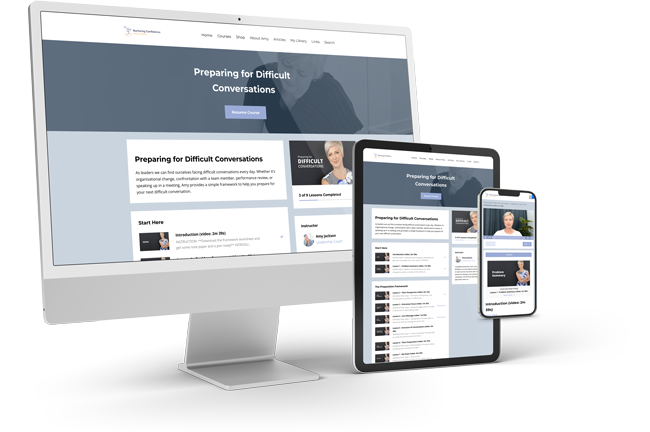
Preparing for Difficult Conversations
-
Short video modules
-
Downloadable preparation worksheet
-
Practical reflection prompts
-
Self-paced access
Total time commitment:
Approximately 30 to 45 minutes to complete the course.
First-time preparation for a difficult conversation may take 15 to 30 minutes using the framework. With practice, many leaders can complete the preparation in 5 to 10 minutes.
You can revisit the framework anytime you need it.
MEET THE INSTRUCTOR
Amy works with leaders who care about their impact.
She understands that difficult conversations are rarely about scripts. They are about mindset, structure and emotional intelligence.
Through her leadership development work, Amy has helped professionals prepare for complex, high-stakes and sensitive conversations with clarity and confidence.
Her approach is practical, grounded and realistic. No theory for theory’s sake. Just tools that work in real workplaces.
This course distils that experience into a framework you can apply immediately.


This course is not for people looking for confrontation tactics or persuasive tricks.
It is not for those who want to avoid responsibility or shift blame.
It is not for leaders who believe difficult conversations should be improvised without preparation.
It is for thoughtful professionals who want to lead well.
Difficult conversations are difficult because they matter.
Avoiding them does not build trust.
Rushing them does not build clarity.
Preparing for them builds leadership, you do not need to be fearless.
You need to be ready.